Thursday, November 18, 2010

Tuesday, November 16, 2010
Wednesday, November 3, 2010
Tuesday, November 2, 2010
Wednesday, April 16, 2008
Under the Banyan Tree - The Wizard of Oz, Singin' in the Rain
The National Museum Cinematheque continues its popular "Under The Banyan Tree" series of outdoor screenings:
Fri 25 April - The Wizard of Oz
Sat 26 April - Singin' in the Rain
It's free! Turn up early to get good seats on the lawn :)
Fri 25 April - The Wizard of Oz
Sat 26 April - Singin' in the Rain
It's free! Turn up early to get good seats on the lawn :)
Tuesday, April 15, 2008
Akan Datang - Manufactured Landscapes, Kes, Picnic at Hanging Rock
Movie-ed out after SIFF? Hope not :)
The Singapore Film Society is screening the documentary Manufactured Landscapes, based on the stunning work of photographer Edward Burtynsky.
MANUFACTURED LANDSCAPES
Sat 26 Apr
The Picturehouse
12:30pm Screening
2:00pm Post Screening Discussion
Youtube trailer:
-----
If you've been to the National Museum lately, you'd have also seen the new ads for the World Cinema Series that SFS co-programs with the National Museum Cinematheque.
In May we're screening Ken Loach's Kes:
KES
Tues 6 May
Gallery Theatre
7:30pm
And on 10 June, look out for Peter Weir's Picnic at Hanging Rock.
The Singapore Film Society is screening the documentary Manufactured Landscapes, based on the stunning work of photographer Edward Burtynsky.
MANUFACTURED LANDSCAPES
Sat 26 Apr
The Picturehouse
12:30pm Screening
2:00pm Post Screening Discussion
MANUFACTURED LANDSCAPES is a feature length documentary on the world and work of renowned artist Edward Burtynsky. Burtynsky makes large-scale photographs of ‘manufactured landscapes’ – quarries, recycling yards, factories, mines, dams. He photographs civilization’s materials and debris, but in a way people describe as “stunning” or “beautiful,” and so raises all kinds of questions about ethics and aesthetics without trying to easily answer them. (read more...)
Youtube trailer:
-----
If you've been to the National Museum lately, you'd have also seen the new ads for the World Cinema Series that SFS co-programs with the National Museum Cinematheque.
In May we're screening Ken Loach's Kes:
KES
Tues 6 May
Gallery Theatre
7:30pm
A realistic, unsentimental and poignant portrait of youth and education, KES is one of Loach's most impassionate and best films. The film won two BAFTA awards when it was released and is ranked seventh in the British Film Institute's selection of the favourite British films of the 20th century. David Bradley's naturalistic and
memorable performance as the young Billy Casper has often been regarded as one of the great adolescent portraits in cinema, joining the ranks of Jean-Pierre Leaud in François Truffaut's THE 400 BLOWS 1959). (read more...)
And on 10 June, look out for Peter Weir's Picnic at Hanging Rock.
Monday, April 14, 2008
SIFF 2008 -- Milky Way Liberation Front, Keronchong for Pak Bakar, After the Rain
Leaving the cinema after the end credits for Milky Way Liberation Front rolled, that was the end of SIFF 2008 for me. I was already tired when we sat down to watch that movie. It was a good way to end the festival. Milky Way Liberation Front was fun, a long string of gags that gently poke fun at indie filmmaking, film festivals and the people who participate in them.
-----
Like his first short Datura, Abdul Nizam's Keronchong for Pak Bakar is distinguished by impressionistic editing with strong narration and the use of vocabulary with religious undertones. There isn't a clear narrative or chronological momentum, but the mix of image and narration can be slightly hypnotic.
I agree with Tan Pin Pin's comments about the film: the work is concerned more with Abdul Nizam's relationship with Abu Bakar bin Ali than with the latter's past. In fact the documentary strongly suggests that the Abdul Nizam in the film is seeking a father figure identified with the golden age of Malay cinema. This search is expressed early in the movie as a search to know more about movie legend P Ramlee, through which Abdul Nizam discovers serendipitously that the man who lensed many of his movies lived just above him. At one point, Abdul Nizam expresses in regretful tones how he discovered too late that his hardworking father had loved film stars and movies. Throughout, Abdul Nizam is extremely respectful - even protective - towards Abu Bakar.
The material used in the documentary come from two major sources. The first is clearly the recorded footage from Abdul Nizam's conversations with Abu Bakar. The second is more mysterious -- footage of a train journey up Malaysia to Penang, ostensibly taken while location scouting for a feature film on P Ramlee's life (according to Abdul Nizam the project eventually fell through).
Empty spaces feature prominently here, partly illustrating Pak Bakar's current solitude. When I asked Abdul Nizam why he weaved in the silent, lonely sequences from his train journey, he indicated that it was partly to convince Abu Bakar to come out of his solitude more often, perhaps to work on film again.
That documentary left the audience with far more questions about Abu Bakar Ali than answers. Why did Abu Bakar stop working on films? Why does he mostly talk about technical matters -- for most of the documentary he is fiddling with an old Bolex handheld camera -- and nothing about himself?
-----
I'm still surprised that SIFF screened Royston Tan's latest short "film" After the Rain before Keronchong for Pak Bakar. Rose-tinted nostalgia and banal cliches (the father coughs to prefigure his eventual death) pliantly placed in the service of the government's ideological imperatives. This is an unabashed propaganda piece.
-----
Like his first short Datura, Abdul Nizam's Keronchong for Pak Bakar is distinguished by impressionistic editing with strong narration and the use of vocabulary with religious undertones. There isn't a clear narrative or chronological momentum, but the mix of image and narration can be slightly hypnotic.
I agree with Tan Pin Pin's comments about the film: the work is concerned more with Abdul Nizam's relationship with Abu Bakar bin Ali than with the latter's past. In fact the documentary strongly suggests that the Abdul Nizam in the film is seeking a father figure identified with the golden age of Malay cinema. This search is expressed early in the movie as a search to know more about movie legend P Ramlee, through which Abdul Nizam discovers serendipitously that the man who lensed many of his movies lived just above him. At one point, Abdul Nizam expresses in regretful tones how he discovered too late that his hardworking father had loved film stars and movies. Throughout, Abdul Nizam is extremely respectful - even protective - towards Abu Bakar.
The material used in the documentary come from two major sources. The first is clearly the recorded footage from Abdul Nizam's conversations with Abu Bakar. The second is more mysterious -- footage of a train journey up Malaysia to Penang, ostensibly taken while location scouting for a feature film on P Ramlee's life (according to Abdul Nizam the project eventually fell through).
Empty spaces feature prominently here, partly illustrating Pak Bakar's current solitude. When I asked Abdul Nizam why he weaved in the silent, lonely sequences from his train journey, he indicated that it was partly to convince Abu Bakar to come out of his solitude more often, perhaps to work on film again.
That documentary left the audience with far more questions about Abu Bakar Ali than answers. Why did Abu Bakar stop working on films? Why does he mostly talk about technical matters -- for most of the documentary he is fiddling with an old Bolex handheld camera -- and nothing about himself?
-----
I'm still surprised that SIFF screened Royston Tan's latest short "film" After the Rain before Keronchong for Pak Bakar. Rose-tinted nostalgia and banal cliches (the father coughs to prefigure his eventual death) pliantly placed in the service of the government's ideological imperatives. This is an unabashed propaganda piece.
Sunday, April 13, 2008
IFFS Film Exchange Program
Got a short film you'd like to show?
Call For Entries - International Federation of Film Societies (IFFS) - Film Exchange Program
The Singapore Film Society in association with the International Federation of Film Societies (IFFS) is proud to promote the IFFS Film Exchange.
This film exchange is a non—profit initiative to drive the appreciation and understanding of cultural and creative works across the world - works which would otherwise remain unknown, unseen and unappreciated.
The 3 groups of countries that are participating in this exchange program are:
1. Latin America
2. Europe
3. Asia
Rationale for the Film Exchange Program
International Federation of Film Societies (IFFS) brings together the film societies of the world for the common aim of facilitating and promoting the exhibition and appreciation of cinematic works.
The IFFS believe that many worthwhile films (both long and short) do not screened outside of its country. Only films which have won prizes at major film festivals tend to get international distribution, sales or exhibition. A film as a form of creative work, and an international language medium, deserves to be seen. Specifically, the
IFFS Film Exchange Program aims to:
1. Broaden the scope for cultural exchange (through the film medium) among the countries of the world, through the extensive contacts and network of the IFFS.
2. Increase the opportunities for the global audience to see samples of good quality cinematic works which are not available through normal channels, commercial or otherwise.
3. Enable filmmakers globally to engage with each other, with the hope that such contacts will lead to beneficial exchange and provide inspiration for further creativity.
1. Film Entries
• Films must be submitted before 25 May, 2008 for consideration.
• Films must be submitted on a DVD.
• Films whose original language is not English should be
subtitled in English.
• Filmmakers are to provide suitable information and credits
for each work (e.g. title, director, running time, year of
production; plus a synopsis; filmmaker contact emails/telephone no.).
• Film submissions can be made through the Singapore Film
Society at filmexchange at sfs dot org dot sg
2. Selection of films
• The organiser reserves the right to select films for inclusion in the exchange as it sees fit.
• Films included in the exchange will be announced on the 31 May 2008.
3. Permissions, Rights and Benefits
This is a non-profit initiative to generate an appreciation and understanding of cultural and creative works across the world - works which would otherwise remain unknown, unseen and unappreciated.
• Filmmakers undertake to grant unlimited screenings to the film clubs within the IFFS.
• No fee will be paid to the rights holders, but filmmakers will be acknowledged in the programs.
• Notification will be given to the film-makers prior to the
screening(s) of their films.
Thursday, April 10, 2008
The SFS since 1958 -- A History
Jan Uhde and Yvonne Ng Uhde, authors of Latent Images: Film in Singapore, included a comprehensive history of the Singapore Film Society in their book (later CD-ROM).
They've generously consented to let us reproduce that section on our homepage.
Click here to read the complete extract.
----------
Latent Images is a key academic work on the history and development of Singapore cinema. I recommend the CD-ROM version, released 3 years after the book with some updates. It also contains video clips - interviews and footage of the former Shaw studios at Jalan Ampas.
If you're interested, you can get it online from the Asian Film Archive.
They've generously consented to let us reproduce that section on our homepage.
However, records from the 1960s and 1970s suggest the Film Society might have been active even before 1958. A January 1961 Sunday Times article noted that the Singapore Film Society had been "in existence for six years." Similarly, in February 1971, film critic Koh wrote that the society "had been in existence for some 16 years." In the 19 March 1985 edition of The Singapore Monitor, Wong Sing Yeong claimed that "the Singapore Film Society was formed in 1956 to complement the commercial cinema by screening less popular art films."
Click here to read the complete extract.
----------
Latent Images is a key academic work on the history and development of Singapore cinema. I recommend the CD-ROM version, released 3 years after the book with some updates. It also contains video clips - interviews and footage of the former Shaw studios at Jalan Ampas.
If you're interested, you can get it online from the Asian Film Archive.
Wednesday, April 9, 2008
SIFF Quick Cuts - 8th April 2008
Yep, got a lot to catch up on. I'll be working backwards from my most recent viewings. Hopefully I can get to the Perspectives Film Festival (31 Mar - 4 Apr 2008) before too long.
(Darn it Stefan, don't you sleep? :D )
Vivid
Singapore / 2007 / 30 mins
dir. Sam Loh
Another example of a short film based on an idea rather than a story, the idea here being two strangers connecting with each other via personal items left behind in a hotel room.
(compare with: Il Mare (시월애, Siworae) (2000) and its American remake The Lake House (2006))
The material is clumsily handled though, and ends up a string of romance cliches. For instance the actors fade in and out of scenes to suggest presence, and recognise each other right away when they meet for the first time.
The sensual possibilities of the items – a shawl, cigarettes, lipstick – through which the protagonists build their imagined connection, is never fully, intimately explored. Vivid is coy to the point of emptiness. A bit odd coming from Sam Loh, who's perhaps best known for Outsiders. This was his debut feature film, about two detectives after a necrophiliac serial killer, and was withdrawn from SIFF 2005 after MDA insisted on cuts.
Diminishing Memories II
Singapore / 2007 / 60 min
dir. Eng Yee Peng
The follow up to Diminishing Memories (2005) by Eng Yee Ping, and really a study of her quixotic obsession with her own imagined idea of Lim Chu Kang.
I don't know whether this was deliberate - Eng is not only the director but also appears as herself in the documentary, talking and interviewing people - but there are moments when she realises that she might simply be pursuing a falsehood. For instance, she asks a developer of a agri-tourist attraction if he was planning to dig a well, then later wonders why she asked that question when there was no well on the land to begin with. Eng also includes an interview with her mother who, close to tears, exhorts her to stop being so obsessed with the past. However, at the end of the documentary Eng does not seem to have reached any reconciliation between her ideas of Lim Chu Kang and the present.
Eng's techniques need more sophistication too. Diminishing Memories II looks and feels much better suited for television than cinema (perhaps due to her previous work experience in a Current Affairs Unit at Mediacorp). Eng also often falls back on verbal and visual cliches, most notably in a scene at the end where she stands, looking offscreen into the distance, evening sky behind her, camera angled up at her from a low position while her voiceover decribes her feelings. For me, Eng's singular obsession is the main attraction in this slightly naive, melodramatic work.
(Darn it Stefan, don't you sleep? :D )
Vivid
Singapore / 2007 / 30 mins
dir. Sam Loh
Another example of a short film based on an idea rather than a story, the idea here being two strangers connecting with each other via personal items left behind in a hotel room.
(compare with: Il Mare (시월애, Siworae) (2000) and its American remake The Lake House (2006))
The material is clumsily handled though, and ends up a string of romance cliches. For instance the actors fade in and out of scenes to suggest presence, and recognise each other right away when they meet for the first time.
The sensual possibilities of the items – a shawl, cigarettes, lipstick – through which the protagonists build their imagined connection, is never fully, intimately explored. Vivid is coy to the point of emptiness. A bit odd coming from Sam Loh, who's perhaps best known for Outsiders. This was his debut feature film, about two detectives after a necrophiliac serial killer, and was withdrawn from SIFF 2005 after MDA insisted on cuts.
Diminishing Memories II
Singapore / 2007 / 60 min
dir. Eng Yee Peng
The follow up to Diminishing Memories (2005) by Eng Yee Ping, and really a study of her quixotic obsession with her own imagined idea of Lim Chu Kang.
I don't know whether this was deliberate - Eng is not only the director but also appears as herself in the documentary, talking and interviewing people - but there are moments when she realises that she might simply be pursuing a falsehood. For instance, she asks a developer of a agri-tourist attraction if he was planning to dig a well, then later wonders why she asked that question when there was no well on the land to begin with. Eng also includes an interview with her mother who, close to tears, exhorts her to stop being so obsessed with the past. However, at the end of the documentary Eng does not seem to have reached any reconciliation between her ideas of Lim Chu Kang and the present.
Eng's techniques need more sophistication too. Diminishing Memories II looks and feels much better suited for television than cinema (perhaps due to her previous work experience in a Current Affairs Unit at Mediacorp). Eng also often falls back on verbal and visual cliches, most notably in a scene at the end where she stands, looking offscreen into the distance, evening sky behind her, camera angled up at her from a low position while her voiceover decribes her feelings. For me, Eng's singular obsession is the main attraction in this slightly naive, melodramatic work.
DigiCon 6+3 ; ASFI presentation - 20 April 2008
The SFS together with MDA, Mediaction and *scape, present a free screening of winning animation shorts from last year's Digicon 6.
Venue:
*scape Lab
113 Somerset Road
Singapore 238165
2pm – 3.30 pm: DigiCon 6+3 screening
3.30 pm – 4.30 pm: Animated Short Film Initiative presentation
Screenings include Grand Prize winner, Toshiaki Hanzaki's Birthday, and Outstanding Performance winners: Ryu Kato's Around, Southern Star Singapore's Old Lightning and Taketo Shinkai's Yama to Hito.
Tokyo Broadcasting System Inc (TBS) has organised DigiCon6 since 2000, to discover and support new animation talent throughout Asia.
And after the screenings, stay for the presentation and Q&A on the SFS-MDA Animated Short Film Initiative, a scheme to fund animated short films of up to 30 minutes. Selected short films funded by other international funding bodies will also be screened.
Free admission for screenings and presentations. But seating space is limited.
If you've any questions please don't hesitate to email animation at sfs dot org dot sg.
Venue:
*scape Lab
113 Somerset Road
Singapore 238165
2pm – 3.30 pm: DigiCon 6+3 screening
3.30 pm – 4.30 pm: Animated Short Film Initiative presentation
Screenings include Grand Prize winner, Toshiaki Hanzaki's Birthday, and Outstanding Performance winners: Ryu Kato's Around, Southern Star Singapore's Old Lightning and Taketo Shinkai's Yama to Hito.
Tokyo Broadcasting System Inc (TBS) has organised DigiCon6 since 2000, to discover and support new animation talent throughout Asia.
And after the screenings, stay for the presentation and Q&A on the SFS-MDA Animated Short Film Initiative, a scheme to fund animated short films of up to 30 minutes. Selected short films funded by other international funding bodies will also be screened.
Free admission for screenings and presentations. But seating space is limited.
If you've any questions please don't hesitate to email animation at sfs dot org dot sg.
Tuesday, April 1, 2008
"Megumi" gets anime treatment
At last year's Japanese Film Festival, we screened the documentary Abduction: The Megumi Yokota Story. , about a 13 year-old girl kidnapped by North Koreans in 1977.
Now there's a 25 min anime version of the story (though not, it seems, based on the documentary)

No need to wait for a film festival this time -- it's available for free downloading off the Japanese government's Headquarters for the Abduction Issue website.
(From Anime News Network)
Now there's a 25 min anime version of the story (though not, it seems, based on the documentary)
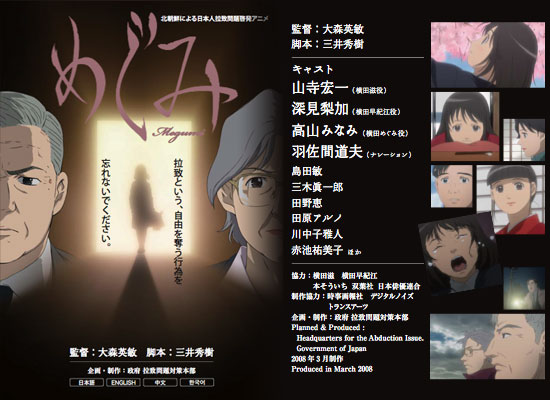
No need to wait for a film festival this time -- it's available for free downloading off the Japanese government's Headquarters for the Abduction Issue website.
(From Anime News Network)
Friday, March 28, 2008
Todd Solondz at The Picturehouse - 21 March 2008
Managed to get tickets to Tisch Asia's exclusive screening of Happiness and Q&A with director Todd Solondz.
Solondz was here for a week to mentor the Tisch students. Naturally his work was shown (at the Tisch Open House we saw a little stand outside their screening theatre advertising Welcome to the Dollhouse), and Tisch kept Happiness for the final screening at The Picturehouse.
Solondz really looks geeky. Balding, with graying hair and a paunch. That evening he wore a short-sleeved light blue shirt paired with khakis. Most memorable were the pale yellow Chucks Taylors on his feet, the oversized thick plastic glasses on his face, and the plastic bag all the way from NYC's The Strand bookshop in his hand -- Woody Allen as if he'd come of age in the 90's.

Solondz was good-humoured and self-effacing. The harshest thing he said was an oblique remark concerning a student's decision to shoot an experimental film here - why spend so much time and money to come here in the first place?
Filmmakers needed to be observant -- "everything is material." His life wasn't any more interesting than anyone else's. No traumatic past either. Singapore was extremely interesting to him as an outsider, and he saw lots that that Singaporeans tended to tune out or ignore.
Solondz commented that he was fortunate to have gotten this movie made. An actor's union (sorry couldn't catch the acronym) had cautioned against the script, probably because of the paedophilia and child rape references.
Luckily, Solondz was popular after the unexpected success of Welcome to the Dollhouse. He managed to get the backing of a senior studio exec, and knew that this was pretty much the only chance he would have to get Happiness made.
Solondz's direction was minimal. He concentrated on setting the "atmosphere" and let the actors do their work. Solondz also noted that he didn't have a problem with the child actors. Natually their parents were involved from the start, but the kids seemed to understand, in their own way, what was going on in the script.
For example, in the scene where the rapist confesses his actions to his son, Solondz didn't ask the child actor to cry, but somehow that emerged through the takes, as both actors played off each other (consciously or otherwise). Solondz had great footage, but unfortunately discovered in the lab that it was unusable. He had to reshoot the scene 2 weeks after.
Solondz also expressed a preference for writing and editing to directing. To him editing was like writing but with footage.
About the movie
Solondz's good at scripting awkward situations based on everyday encounters, highlighting the little lies people tell each other everyday to get by. Clever, sharp dialogue but characterisation spotty e.g. Trish, Helen characters are caricatures.
He also expounds a cynical view of love, sex and inter-personal communication. Sincere bonds are few and don't last long.
What's I particularly like about it are the strong performances from overlooked actors, especially Dylan Baker. Some of the actors have gone on to do well in TV (e.g. Lara Flynn Boyle, Camryn Manheim). Seymour Philip Hoffman's the only one who eventually made the A-list after Capote, years after. And the trivia nut in me wants to point out Ben Gazzara who starred in Saint Jack.
-----
Incidentally, is Hoffman the only actor to appear on two movie poster drawn by comic book artists? Hoffman is prominent in the poster for Happiness, illustrated by Daniel Clowes (Ghost World), and he appears on the poster for The Savages (earlier post)
Solondz was here for a week to mentor the Tisch students. Naturally his work was shown (at the Tisch Open House we saw a little stand outside their screening theatre advertising Welcome to the Dollhouse), and Tisch kept Happiness for the final screening at The Picturehouse.
Solondz really looks geeky. Balding, with graying hair and a paunch. That evening he wore a short-sleeved light blue shirt paired with khakis. Most memorable were the pale yellow Chucks Taylors on his feet, the oversized thick plastic glasses on his face, and the plastic bag all the way from NYC's The Strand bookshop in his hand -- Woody Allen as if he'd come of age in the 90's.

Solondz was good-humoured and self-effacing. The harshest thing he said was an oblique remark concerning a student's decision to shoot an experimental film here - why spend so much time and money to come here in the first place?
Filmmakers needed to be observant -- "everything is material." His life wasn't any more interesting than anyone else's. No traumatic past either. Singapore was extremely interesting to him as an outsider, and he saw lots that that Singaporeans tended to tune out or ignore.
Solondz commented that he was fortunate to have gotten this movie made. An actor's union (sorry couldn't catch the acronym) had cautioned against the script, probably because of the paedophilia and child rape references.
Luckily, Solondz was popular after the unexpected success of Welcome to the Dollhouse. He managed to get the backing of a senior studio exec, and knew that this was pretty much the only chance he would have to get Happiness made.
Solondz's direction was minimal. He concentrated on setting the "atmosphere" and let the actors do their work. Solondz also noted that he didn't have a problem with the child actors. Natually their parents were involved from the start, but the kids seemed to understand, in their own way, what was going on in the script.
For example, in the scene where the rapist confesses his actions to his son, Solondz didn't ask the child actor to cry, but somehow that emerged through the takes, as both actors played off each other (consciously or otherwise). Solondz had great footage, but unfortunately discovered in the lab that it was unusable. He had to reshoot the scene 2 weeks after.
Solondz also expressed a preference for writing and editing to directing. To him editing was like writing but with footage.
About the movie
Solondz's good at scripting awkward situations based on everyday encounters, highlighting the little lies people tell each other everyday to get by. Clever, sharp dialogue but characterisation spotty e.g. Trish, Helen characters are caricatures.
He also expounds a cynical view of love, sex and inter-personal communication. Sincere bonds are few and don't last long.
What's I particularly like about it are the strong performances from overlooked actors, especially Dylan Baker. Some of the actors have gone on to do well in TV (e.g. Lara Flynn Boyle, Camryn Manheim). Seymour Philip Hoffman's the only one who eventually made the A-list after Capote, years after. And the trivia nut in me wants to point out Ben Gazzara who starred in Saint Jack.
-----
Incidentally, is Hoffman the only actor to appear on two movie poster drawn by comic book artists? Hoffman is prominent in the poster for Happiness, illustrated by Daniel Clowes (Ghost World), and he appears on the poster for The Savages (earlier post)
Tuesday, March 11, 2008
Something Different
Watching A Flower In Hell reminded me of another movie I saw: Gate of Flesh. Maybe, they are not quite the same. After all Gate of Flesh is supposed to be an 'adult release' and is more lurid with scenes of torture, but both take places after a war. The mise en scene are dilapidated makeshift houses against what seems to be a bombed out landscape (ok, that's a little exaggerated, but you get the idea). The male protagonists are betrayed. Innocent minds are corrupted.
But there's a grittier feel to A Flower in Hell: there's no music, which is something quite refreshing really, compared to today's heavily orchestrated films (the films of the Coen Brothers being notable exceptions). Also for a melodrama, it's surprisingly restrained in hyperbolic dialogue - being forced to watch those awful Singaporean English dramas, I became agonizingly aware how incapable local scriptwriters are of using gestures or expressions, preferring to vocalize everything.
I guess I was in the mood for it, a movie from another era, which made it quite fascinating, watching the dances they did and wondering how folks once thought they were so cool. A glimpse into a world that's vanished.
But there's a grittier feel to A Flower in Hell: there's no music, which is something quite refreshing really, compared to today's heavily orchestrated films (the films of the Coen Brothers being notable exceptions). Also for a melodrama, it's surprisingly restrained in hyperbolic dialogue - being forced to watch those awful Singaporean English dramas, I became agonizingly aware how incapable local scriptwriters are of using gestures or expressions, preferring to vocalize everything.
I guess I was in the mood for it, a movie from another era, which made it quite fascinating, watching the dances they did and wondering how folks once thought they were so cool. A glimpse into a world that's vanished.
Wednesday, February 27, 2008
Monday, February 25, 2008
The Winners
Here's the list of winners.
It's, for lack of a better word, all too predictable, so much so that I can't even be bothered to have an opinion about it.
What is far more interesting is the future. As the business goes online and the audience begins to interact with films rather than being passive observers, will the whole idea of the auteur finally implode? If today's indies compete with industry heavies, tomorrow's director wannabes deal with a fickle consumer crowd and if TV is any indication, democracy will cater to the lower denominator.
Hmm, maybe that is too bleak, but look at it this way: when sound came, silent films soon became extinct. In the same way, when a new business model, a new distribution network emerge, some types of films will simply be harder to make. Unlike, novels, music or art (except large installation pieces and such) which require very little resources and hence are mostly a result of individual effort, films are massive collaborative business deals. The idea of the auteur is a myth. The idea that you can make any film where your vision takes you is probably not realistic. That is why money men matter so much in movies.
It's, for lack of a better word, all too predictable, so much so that I can't even be bothered to have an opinion about it.
What is far more interesting is the future. As the business goes online and the audience begins to interact with films rather than being passive observers, will the whole idea of the auteur finally implode? If today's indies compete with industry heavies, tomorrow's director wannabes deal with a fickle consumer crowd and if TV is any indication, democracy will cater to the lower denominator.
Hmm, maybe that is too bleak, but look at it this way: when sound came, silent films soon became extinct. In the same way, when a new business model, a new distribution network emerge, some types of films will simply be harder to make. Unlike, novels, music or art (except large installation pieces and such) which require very little resources and hence are mostly a result of individual effort, films are massive collaborative business deals. The idea of the auteur is a myth. The idea that you can make any film where your vision takes you is probably not realistic. That is why money men matter so much in movies.
Saturday, February 23, 2008
The Real Bauby Story
Sometimes they say art transcends truth which reminds me that I must read Nazi Literature in the Americas by Roberto Bolano in which he explores how "literature is an unnervingly protean, amoral force with uncanny powers of self-invention, self-justification and self-mythification."
Here's the back story of The Diving Bell and The Butterfly. Basically, it comes down to this: the film does not reflect the truth. It's beautiful but untrue. Does it necessarily detract from the work? I think to say no would be lying.
Here's the back story of The Diving Bell and The Butterfly. Basically, it comes down to this: the film does not reflect the truth. It's beautiful but untrue. Does it necessarily detract from the work? I think to say no would be lying.
Thursday, February 21, 2008
Juno
It's not exactly, you know, epic! But how can one hate Juno, it's like hating Friends: makes everyone think you're mean. Although, the impression I get from the film is Wes Anderson making a light-hearted sitcom. Juno's father reminds me of Wilson from Home Improvement, Tim Allen's neighbour who we never see, who gives such penetrating, cheesy advice. It's just inevitable that I have to compare it to a sitcom because of the non-stop one-liners. There's no situation you can't handle by making a wisecrack.

Tuesday, February 19, 2008
Rvw: Persepolis

Persepolis (PG, 95 minutes)
One of the surprise nominees for this year's Best Animated Film is the adaptation of Marjane Satrapi's graphic novels, Persepolis. This French animation, done mostly in black and white, is the coming-of-age story of a young girl in Iran who is sent to Europe to escape the rising wave of Islamic fundamentalism that swallows the country. However, she returns home to Iran after being unable to fit in, but she still remains a stranger in Tehran. It's a deftly told story, with many charming and powerful moments, such as Satrapi's devotion to rock music that lands her into trouble with the authorities. The version screened here is dubbed in English, and the American-accented English is occasionally jarring. Nonetheless, it's still a powerful film that's an extraordinary piece of work. Rating: A
Monday, February 18, 2008
Just For Oscar
How wonderful that they finally made up. Now, we can get back to schmoozing and partying. Meanwhile, have we grown any wiser? Beyond the hype and the hate, is there any meaning to all the hoopla? I think the answer to that is that it's all about the hoopla. Always has been, always will be.
Subscribe to:
Posts (Atom)


